How a Conveyor Wagon Changes Harvest Season on a Multi-Crop Farm
It’s the busiest morning of your season, and the sweet corn is ready. So is the squash, and the melons are right behind. You’ve got a crew of eight, a packing shed at one end of the field, and rows that look like they run to next week.
Everybody's picking, but here's the part nobody factors into the schedule: most of the day isn't spent picking; it's spent walking, carrying, setting a full bin down, straightening up, and heading back for the next one.
That walking and hauling isn’t just quietly eating your harvest budget; it's also wearing down the backs of the people you count on most. And when they’re sore and exhausted, the quality of work goes down, mistakes get made, and worse, they get hurt.
First, a quick word about us: we're Harvest Pro, and we've spent more than 40 years and three generations building labor-saving equipment for produce farms. We make a conveyor wagon of our own, and we'll get to that at the end.
But the idea behind a conveyor wagon is worth understanding, no matter whose name is on the side. So let's start with the tool itself and what it changes about your harvest day.
TL;DR: How Conveyor Wagons Benefit Multi-Crop Farms
- Harvest is primarily a labor-intensive moving job; conveyor wagons shift the focus from hauling to picking.
- By using a conveyor belt, produce moves directly to the packer, eliminating back-breaking carrying and reducing wasted time.
- Conveyor wagons offer high versatility for multi-crop farms, effectively handling a wide variety of produce.
- Reducing physical strain and repetitive labor is a key retention strategy, keeping your skilled crew healthy and productive.
- Less handling of produce directly reduces bruising and damage, ensuring fresher, higher-quality products.
Harvest Is Really a Moving Job
We like to think of harvest as picking. Grab the produce, fill the box, done.
But picking is only half of it. The other half is moving what you picked. Out of the row. Onto a wagon or truck. Over to the packer. Then the long walk back to the row to start again.
On a multi-crop farm, that back-and-forth piles up fast. Different crops, different rows, different corners of the field, all day long. And every empty-handed walk back is time you're paying for but getting nothing from.
This matters more than most of us realize, because labor is the single biggest cost in produce. According to the USDA's Economic Research Service, wages and contract labor account for about 40 percent of production expenses on fruit and vegetable operations, compared with roughly 12 percent for farms overall. When nearly half of what you spend goes to people, how those people spend their hours becomes the whole ballgame.
Here's the kicker. A lot of those expensive hours go to hauling, not harvesting.
What a Conveyor Wagon Actually Does
A conveyor wagon is what it sounds like. A wagon with a long conveyor belt mounted on top.
The crew picks and sets the produce on the belt. The belt carries the crop up to a packer riding on the wagon, who boxes it on the spot. The wagon rolls down the row at picking pace, usually powered by your tractor's hydraulics.
Notice what just happened. You stopped moving the crop. The crop started moving itself.
That's the whole idea. Instead of each worker carrying loads to the edge of the field, the produce travels the belt while the crew keeps both hands in the rows. No hauling. No trips back. No bottleneck at the truck.

Think of it like a checkout line at the grocery store. You don't carry each item to the register one at a time. You set everything on the belt, and it comes to the cashier. A conveyor wagon brings that same logic to your field.
Why It Fits a Multi-Crop Farm So Well
A single-crop operation can sometimes justify a big, specialized harvester built for one job. Most diversified farms can't. You're growing five, ten, fifteen different things, and a machine that only handles one of them is a tough sell.
A conveyor wagon is different because it doesn't care much what's on the belt.
- Sweet corn one week, pumpkins the next
- Melons, squash, broccoli, cauliflower, cabbage, lettuce
- Heavy crops that are miserable to carry and bulky crops that are awkward to stack
One tool, many jobs, for the whole season. For a multi-crop grower, that flexibility is the difference between equipment that earns its keep and equipment that gathers dust by July.
Adjustable height helps here too. A belt you can raise or lower meets each crew where the work is, whether you're bending low for melons or loading higher for boxed greens.
Your Crew's Knees and Back
Let's get to the part that doesn't show up on a spreadsheet but absolutely should.
Harvest work is hard on the human body. Lower back pain is one of the most serious health problems farmworkers face, and it often comes from carrying heavy loads and working long hours in a stooped posture, according to the Western Center for Agricultural Health and Safety at UC Davis. Hauling full harvest boxes all day, every day, is exactly the kind of strain that wears the body down over time.
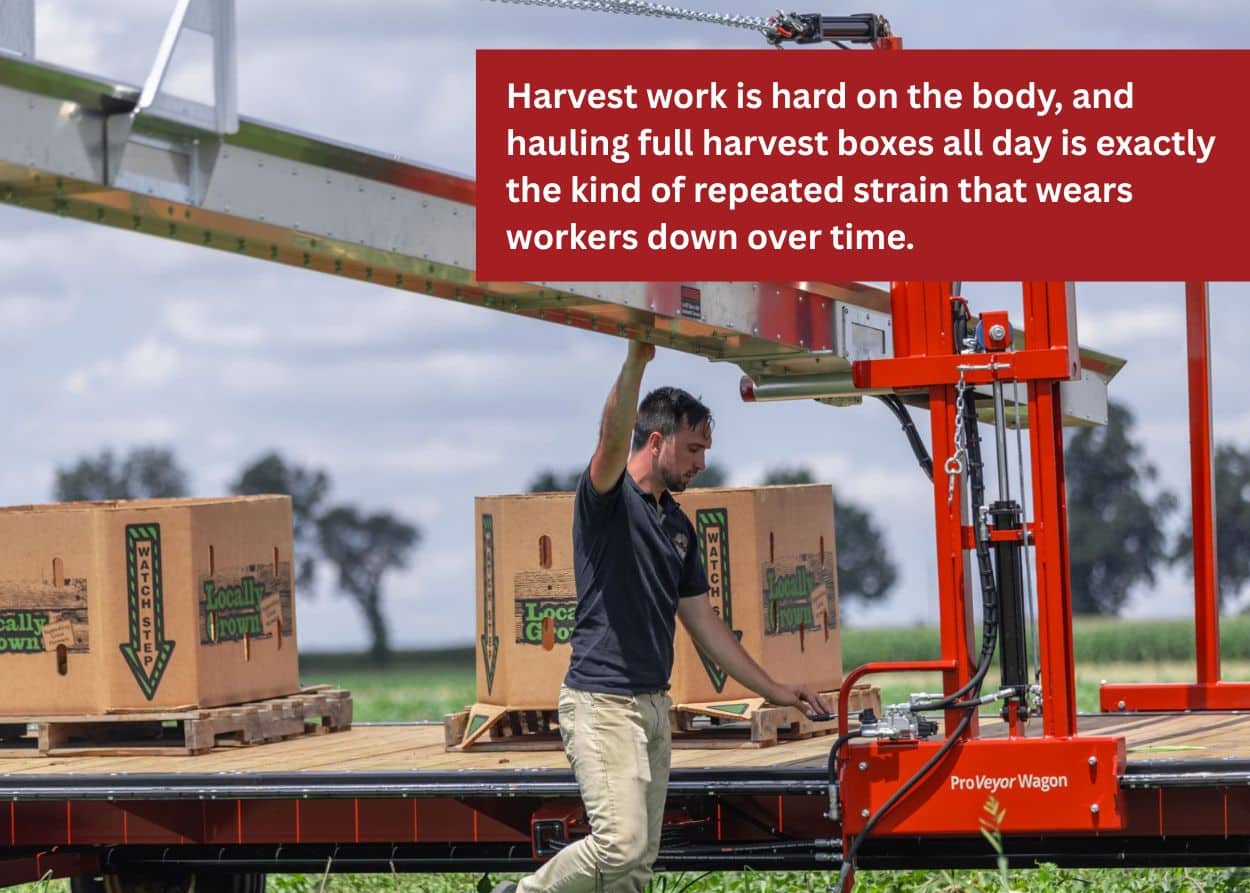
Now think about what the conveyor takes off your crew's shoulders. The heavy carrying. The repeated trips. The bending to lift a full bin and the twisting to set it on a truck. Most of that just goes away when the belt does the moving.
Why should you care, beyond doing right by your people? Because good workers are getting harder to find. USDA reports that produce operators are struggling to fill jobs in a tight labor market, with farm wages climbing fast. When a skilled picker is this valuable, you want that picker coming back next season. A job that doesn't break the body is a job people keep.
So the back-saving part isn't soft and fuzzy. It's a retention strategy.
A Freshness Bonus You Might Not Expect
Here's a benefit that sneaks up on people.
Every time produce gets handled, dropped in a bin, hauled across a field, or dumped into another bin, you risk bruising and damage. More touches, more loss.
A conveyor wagon cuts the number of touches. Pick, set on the belt, pack. The crop goes from row to box in one smooth move and heads for the cooler sooner. Less handling, less bruising, fresher product on the truck.

For anyone selling to grocery stores, wholesalers, or a demanding farmstand crowd, that's money. Quality is what brings buyers back.
What to Look For If You're Shopping for One
Not all conveyor wagons are built the same. If you're weighing the idea, here are the things worth checking before you spend a dollar:
- Length options. Longer belts cover more row and feed bigger crews. Match the size to your fields, not the other way around.
- Adjustable conveyor height. A belt that raises and lowers handles more crops and is kinder on a wide range of workers.
- Tilt and angle adjustment. Small tweaks make a real difference in how smoothly product rides the belt.
- Power source. Most run off tractor hydraulics. If you farm with horses, make sure a standalone hydraulic option exists.
- Tires and flooring. Low-profile tires and a solid, treated floor keep the wagon steady on soft or uneven ground.
- Build quality and support. Ask about the warranty and whether you can actually reach a human when something needs fixing.
A good conveyor wagon should feel less like a gadget and more like a sturdy work partner that shows up season after season.
While We're on the Subject
Now, the part we promised up top. We built one of these.
We make the ProVeyor Wagon and Trailer, a hydraulic conveyor wagon designed for exactly the kind of multi-crop harvest we've been describing. We came at the design the way we come at all our equipment, by working backward from the grower's real day and stripping out wasted steps.
A few things we're proud of:
- Comes in 18, 24, or 30 foot lengths, so you can size to your fields and your crew
- Conveyor height adjusts from 14 to 40 inches off the wagon bed, plus tilt-angle adjustment, to flex across crops
- Runs off your tractor's hydraulics, and we can add a hydraulic unit for horse-drawn use
- Built on a sturdy 8-ton Stoltzfus wagon gear with low-profile 10-ply tires and a treated floor
- Handles sweet corn, melons, pumpkins, squash, broccoli, cauliflower, cabbage, lettuce, and more
We're not going to pretend a conveyor wagon is right for every operation. But if you're tired of paying skilled hands to walk empty-handed across a field, and you're watching good workers limp home sore, it's worth a look. We're happy to talk through whether the ProVeyor fits your farm, no pressure either way.
The Bottom Line
A conveyor wagon doesn't change what you grow. It changes how the harvest moves.
At Harvest Pro, we’re all about less hauling. Fewer trips. Easier days for your crew, fresher product for your buyers, and more of your labor budget going toward actual harvesting instead of walking.
That's a quieter kind of win. But on the busiest morning of your season, you'll feel it.
Contact us today to find out how the Proveyor Wagon and Trailer can revolutionize your farm’s efficiency!